The essence of propaganda consists in winning people over to an idea so sincerely, so vitally, that in the end they succumb to it utterly and can never again escape from it.

Joseph Goebbels
The tectonic blueprint of Indian state’s digital surveillancewas laid in August 2019 when the Indian government completely blocked all communication networks in Jammu and Kashmir after revocation of Article 370 and 35A. The absolute state of quarantine for Kashmiris lasted for over 500 days. Dousing the region into a state of imposed isolation, it curbed the basic human rights of denizens usually termed as “Crown Jewel of India” by nationalist leaders. This forced suppression of speech was merely a microcosm of what was going to happen thereafter.
The physical and psychological isolation experienced by Kashmiris was a literal manifestation of what Hannah Arendt termed the “destruction of the public realm”(The Origins of Totalitarianism,1951). For Arendt, totalitarian tendencies begin when the state destroys the spaces where citizens can look at one another, speak, and act in concert. A 28-year-old Kashmiri professional while talking to Human Rights Watchtold that for him, the blackout “felt like the silence of the graveyard,”. His words mirrored the exact state of “totenstille”, an absolute melancholic, dead silence, and this silence was manufactured by the Indian State to prevent any collective political action or resistance.
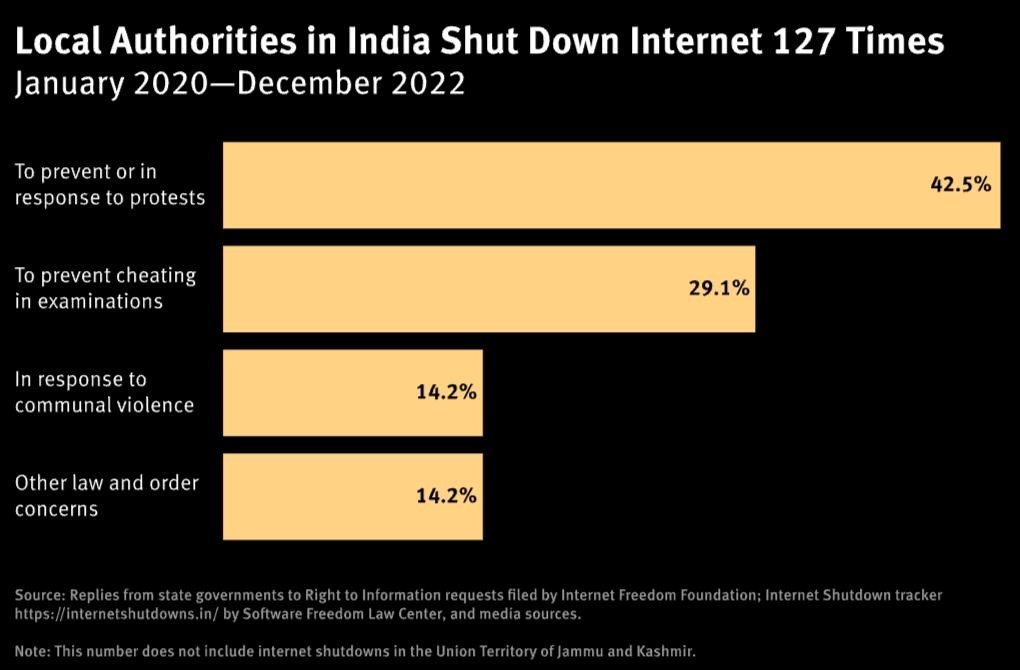
However, the authorities contend the shutdowns are needed to prevent violence fueled by rumours circulated on social media or mobile messaging applications. “There is a big song and dance about the internet being cut. Now, if you’ve reached the stage where you say an internet cut is more dangerous than the loss of human lives, then what can I say?” said India’s External Affairs Minister S. Jaishankar in September 2022.
This rhetorical manoeuver is a classic example of what Foucault sees as the “exercise of biopower” (The History of Sexuality, 1976), here for instance, the state justifying the suspension of rights and liberties by claiming that it is protecting the biological survival of the population. When a state’s primary mission shifts to “protecting and fostering life,” it gains a powerful, moral justification for suppressing dissent. State violence (be it; overt, cultural or structural) is no longer framed as a tyrant protecting his throne, but as a doctor protecting a patient.
Here, thus, the state tried to brush aside international criticism by presenting a false binary between digital access and human lives. By framing a basic right in today’s times like “internet access” as a threat to public safety, the state successfully created a parochial definition of security, where all unmonitored civic interaction could be viewed with innate suspicion and therefore, security is treated as a zero-sum, private good where an increase in one’s own safety is assumed to come at the expense of others. (The national security will come only at an expense of suspension of basic rights of mortal sapiens living within cartographical territories of Kashmir).
Far from being a scrupulous application of emergency powers, which the apex judicial body advised the Indian state in the judgement of Anuradha Bhasin v. Union of India (2020) case (establishing Internet as medium for expressing basic fundamental rights and its indefinite suspension illegal), these persistent state sponsored network cut-offs have now expanded to mundane administrative tasks, like preventing cheating in school examinations.
Moreover, recently, suspending Telegram during the Re-NEET exam exposes an administration at loggerheads with the very concept of ‘constitutional transparency’. It is nothing but a clumsy “shoot the messenger” method enforced by the absolute emasculated state to shield the executive and lawmakers from accountability.
From IT Rules 2021 to the Broadcast Bill
In February 2021, when state authorities, on one hand, were installing iron nails, coils of barbed wires, steel barricades and hundreds of riot police around the borders of New Delhi to stop tens of thousands of protesting farmers from entering the Capital city, the simultaneous introduction of the Information Technology (Intermediary Guidelines and Digital Media Ethics Code) Rules, 2021 through an executive order marked a paradigm shift in how the Indian State interacts with digital platforms.
Bypassing intense parliamentary debate by utilising “delegated legislation” clause, a mechanism tied to Section 87of an archaic parent Act from 2000, the government sidestepped the type of democratic scrutiny that would have exposed the deep constitutional inconsistency of the legislation. The 2021 Rules targeted the structural pillar of digital privacy: end-to-end encryption. It demanded messaging platforms like WhatsApp to build traceability mechanisms under Rule 4(2), to identify the “first originator” of a message, thus, creating a defacto backdoor into private conversations.
This policy was met with immediate repudiation from civil liberties groups and legal challenges from tech companies. The state’s defensive argument, “that national security admits no compromises” serves to obfuscate its deeper ambition i.e, the creation of a digital “Panopticon” (a concept introduced by Jeremy Bentham in his 1791 book, Panopticon). In Foucault’s analysis of the “Panopticon” (Discipline and Punish, 1977), modern power operates not by using constant physical coercion or torture instead by creating a psychological state of permanent visibility, a mental conditioning of constantly being seen and observed by the state. If a citizen believes their private communications can be tracked and unmasked at any moment by a sovereign executive branch acting as judge, jury, and executioner, they will self-censor. Dissent becomes too dangerous to express.
While responding to the TIME, Sidharth Bhatia, founding editor of The Wire observed that these rules were exclusively designed to bring digital media “to heel, to control it, and perhaps intimidate it. It is executive overreach of the worst kind.” The executive overreach intensified following the April 2023 amendments to the IT Rules. The amendments empowered the Union Government to establish a Fact Check Unit(FCU) to particularly identify information relating to the “business of the Central Government” that it considered false, fake, or misleading. Consequently, social media platforms faced increased pressure to remove, restrict the visibility, or over-censor the content flagged by government’s FCU in order to retain their safe-harbour protections under Section 79 of the IT Act, 2000.
This architecture, gave a free hand to the executive to function simultaneously as the complainant, the judge, and the prosecutor of online speech, thus, leading to serious concerns related to freedom of speech and expression (provided to citizens as a fundamental right, under the Article 19(1)(a) of the Indian Constitution) and the absence of independent judicial interventions. However, in Kunal Kamra v. Union of India (2024), the Bombay High Court, by a tie-breaker judgment, struck down the FCU-related amendments as unconstitutional and stated that it ultra vires the parent legislation of 2000. Subsequently, the apex court also declined to stay the High Court’s judgment till further proceedings giving a setback to the union government.
Later that year in November, the draft of Broadcasting Services (Regulation) Bill, 2023 was released for public comments, however it was temporarily withdrawn in 2024 following widespread criticism and coordinated pushback from press freedom bodies like Editors Guild of India (EGI), Press Club of India (PCI), and others. The bill still remains an ominous shadow over the independent press. The EGI at that time observed that the provisions were “intentionally vague and excessively intrusive”. It threatened to bring OTT platforms as well as independent digital creators and individual journalists under the same heavy-handed licensing process subject to extensive scrutiny by the government typically reserved for traditional television or cable networks.
Thus, the State’s persistent effort to reintroduce versions of these bills reveals a total lack of any iota of truth in its claim that it only wishes to sanitise the web from “obscenity” or fake or misleading contents. Instead, the ultimate goal of the State remains a desire to completely eliminate the barely existing wild, cacophony of independent media and replace it with a uniform landscape of institutional sycophancy.
(The writer is an undergrad Political Science student in Jadavpur University, Kolkata.)
References:
Chatterjee, S. (2026, June 2). A Foucauldian reading of the populist regime of truth: Power, truth and Foucauldian lens on populism. Substack. https://open.substack.com/pub/shibashischatterjee/p/a-foucauldian-reading-of-the-populist?utm_source=share&utm_medium=android&r=5j7ekl
Joudi, B. (2024, January 8). Under the digital panopticon: Exploring activism in an era of surveillance. Outlook, American University of Beirut. https://sites.aub.edu.lb/outlook/2024/01/08/under-the-digital-panopticon-exploring-activism-in-an-era-of-surveillance/
Sebastian, M. (2026, March 31). How IT Act powers are killing online dissent. LiveLaw. https://www.livelaw.in/articles/how-it-act-powers-are-killing-online-dissent-528338
SabrangIndia. (2024, January 15). Broadcasting Bill adverse to freedom of speech, freedom of press: Editors Guild of India. https://sabrangindia.in/broadcasting-bill-adverse-to-freedom-of-speech-freedom-of-press-egi/
Human Rights Watch. (2023, June 14). “No internet means no work, no pay, no food”: Internet shutdowns deny access to basic rights in India. https://www.hrw.org/report/2023/06/14/no-internet-means-no-work-no-pay-no-food/internet-shutdowns-deny-access-basic
Shah, F. (2019, August 8). “Anxiety fills the air.” What it’s like inside Kashmir when all communication with the outside world is cut off. Time. https://time.com/5646005/inside-kashmir-communication-shutdown/
Perrigo, B. (2021, March 11). India’s new internet rules are a step toward “digital authoritarianism,” activists say. Here’s what they will mean. Time. https://time.com/5946092/india-internet-rules-impact/
Al Jazeera. (2021, February 3). In pictures: Iron spikes and steel barricades at India’s farmers’ protest. https://www.aljazeera.com/gallery/2021/2/3/in-pictures-iron-spikes-and-steel-barricades-at-farmers-protest
Panjiar, T. (2024, August 30). The bill that never was: The comeback, resistance, and downfall of the Broadcasting Bill. Internet Freedom Foundation. https://internetfreedom.in/a-broadcasting-summary/
Jain, A. (2024, October 8). The Bombay High Court dismisses the Ministry of Truth. Verfassungsblog. https://verfassungsblog.de/india-fact-checking-unit-fake-news/
Roy, R. (2024, March 23). Big relief! Supreme Court stays notification constituting Fact-Check Unit!. Internet Freedom Foundation. https://internetfreedom.in/sc-stays-notification-constituting-fcu/
Mogul, R., & Regan, H. (2024, May 22). Is India’s free press not so free after a decade of Modi? CNN. https://edition.cnn.com/2024/05/22/media/india-elections-press-freedom-decline-intl-hnk