The emergence and expansion of BRICS is not a clear-cut indicator of the alternative to the US imperialism. Neither BRICS has ever stated it, nor it should be seen with those kinds of hopes. But, there is a potential possibility of BRICS becoming instrumental to evolve a threat to the US hegemony. The events happened in last few years in the geo political arena of the world politics, are bringing the countries closer which have been at the receiving end of the US diktats. The proxy war between Ukraine and Russia, which is actually a war between NATO and Russia, the genocide in Palestine, and more recently the war imposed upon Iran by US and Israel are the prominent incidents which accelerated the regrouping of the countries across the world. Indian government is yet in a dilemma whether to continue in the US lobby, or to join the Global South which is emerging rapidly.
The talk by Prof. Manoranjan Mohanty and the discussion followed the talk brought forward these important insights on the developments happening around us every day. Prof. Mohanty was speaking on the topic “Bandung to BRICS: New Challenges” in Ajoy Bhavan, Delhi on 16 June 2026 in a programme organised by Joshi-Adhikari Institute of Social Studies (JAISS).
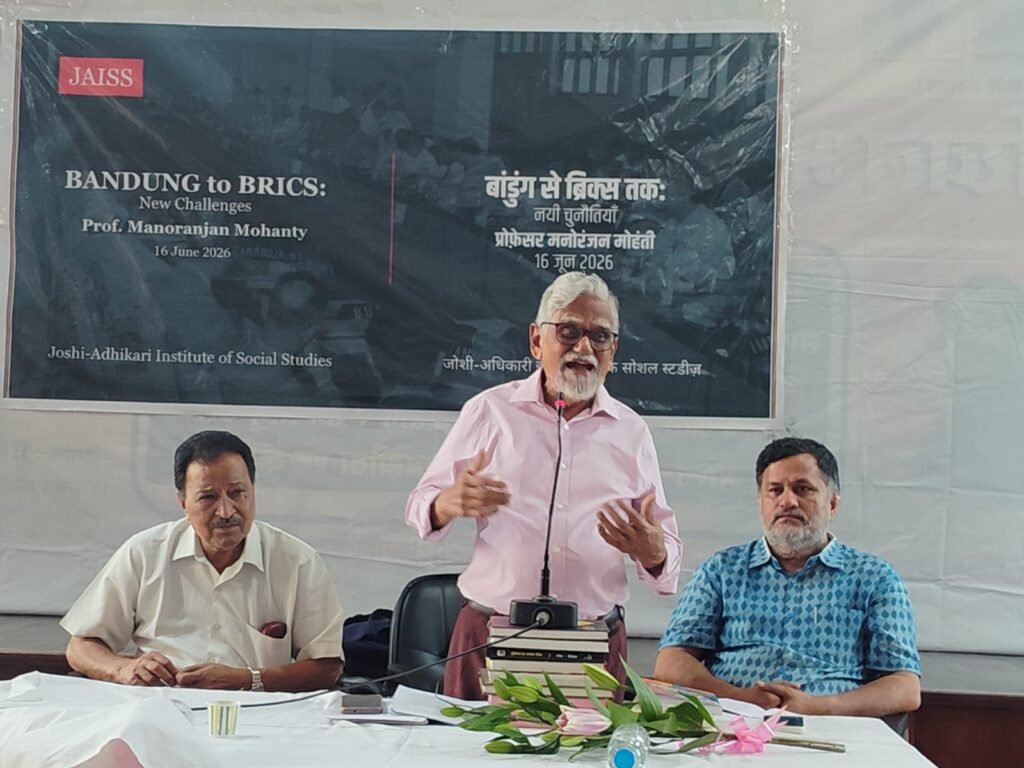
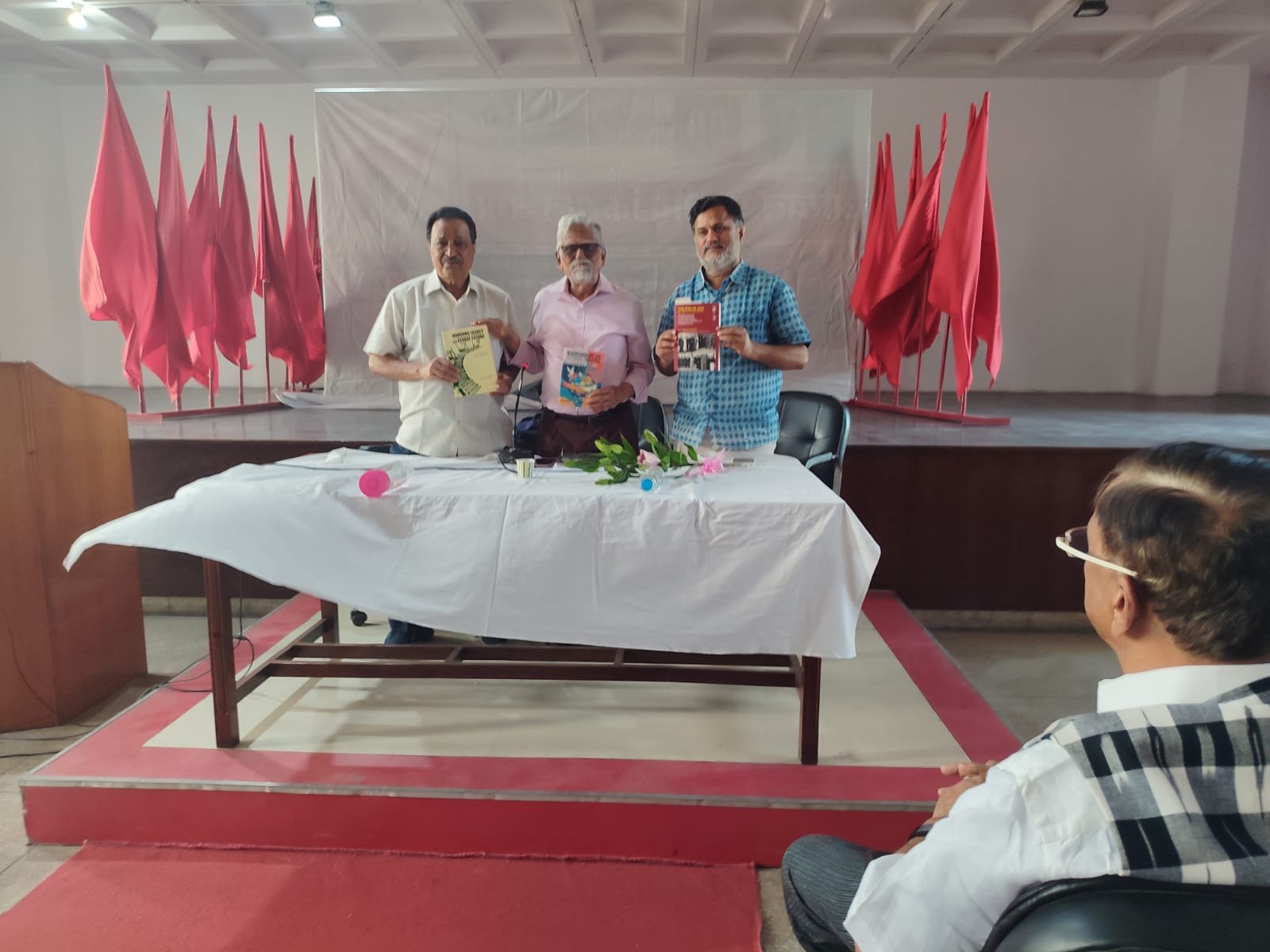
Prof. Mohanty told that After centuries of exploitation, many newly independent former colonies organised this meeting in Bandung, Indonesia, on 18–24 April 1955. Representatives of twenty-nine African Asian nations gathered to discuss peace, multilateral development, and the Global South’s representation in world politics. He listed five major events that shaped the anti-imperialist alternative order. These events were the League Against Imperialism, Brussels (1927), Asian Relations Conference, Delhi (1947), Bandung, Indonesia (1955), Non-Alignment Movement, Belgrade (1961), and the New International Economic Order (1974). He said that the global south had a history of colonialist exploitations, and these countries were observing the rise of imperialist powers, and decided to demonstrate resilience in the form of the Bandung Conference and Non-Alignment movement. Even today, no doubt, imperialism is so strong, but so is opposition to imperialism. Imperialism appears to be so aggressive because it is afraid of opposition to imperialism. And this is the momentum of struggle. It is not an unchallenged dominance. The challenge to this imperialist dominance is visible and so strong. He introduced three books, namely “Bandung Legacy and Global Future”, “Bandung at 70” and “The Rise of Asia” which are of great relevance to the topic concerned.
In the early 2000s, the corporate strategy of the US financial and industrial elites to invite emerging economies into the G7, but the Bandung legacy and the legacy of the apartheid struggle shaped the BRICS as the anti-imperialist bloc. Till now, almost every BRICS meeting has had two common points: the dollar system has to be abandoned, and a more just and inclusive political-economic order should be implemented. The Western powers are completely built upon monopolistic advantages, including the military tech monopoly, information monopoly, financial monopoly and communication monopoly. BRICS had continuously worked on these segments to provide an alternative for unipolar monopolistic imperial powers. It developed the NDB (New Development Bank), gave platforms for multilateral trade, and worked on grain security.
Russia and China are also important founding members of BRICS which are targeted directly by the US in trade through sanctions on these countries and sanctions on other countries which trade with these countries. There are problems in completely bypassing dollar. There are countries including Russia and China which have their reserves in dollars. So, if dollar falls, it will affect the economies of these countries also. The situation is complex but the BRICS countries are trying to evolve a more equitable, just and economic order for trade among themselves.
On 1 January 2026, the rotating chairmanship of the BRICS came to India, but instead of becoming a part of the contributors in BRICS for its institutional developments, India is working as a compromised member in BRICS. India is not ready to completely delink from Dollar centric financial and monetary system. At the same time, India has had historically friendly trade relations with countries of South and Russia. Therefore, it is trying to balance the two antagonistic trade and investment coordinate frames. South Africa and Brazil became two of the most active members of BRICS. It’s also a general misconception that BRICS is an alternative to the UN; instead, it’s actually to strengthen the UN. So, the idea is to recover the political perspective of the Global South through a multipolar alternative.
Com. Rama Krushna Panda, National Secretary of CPI, chaired the meeting. He introduced Prof. Manoranjan Mohanty too. Prof. Ajay Patnaik, Director of JAISS, began the programme with a short reference from Asian Relations conference, 1946, which shaped initial multilateralism in Asian countries to the formation of BRICS.
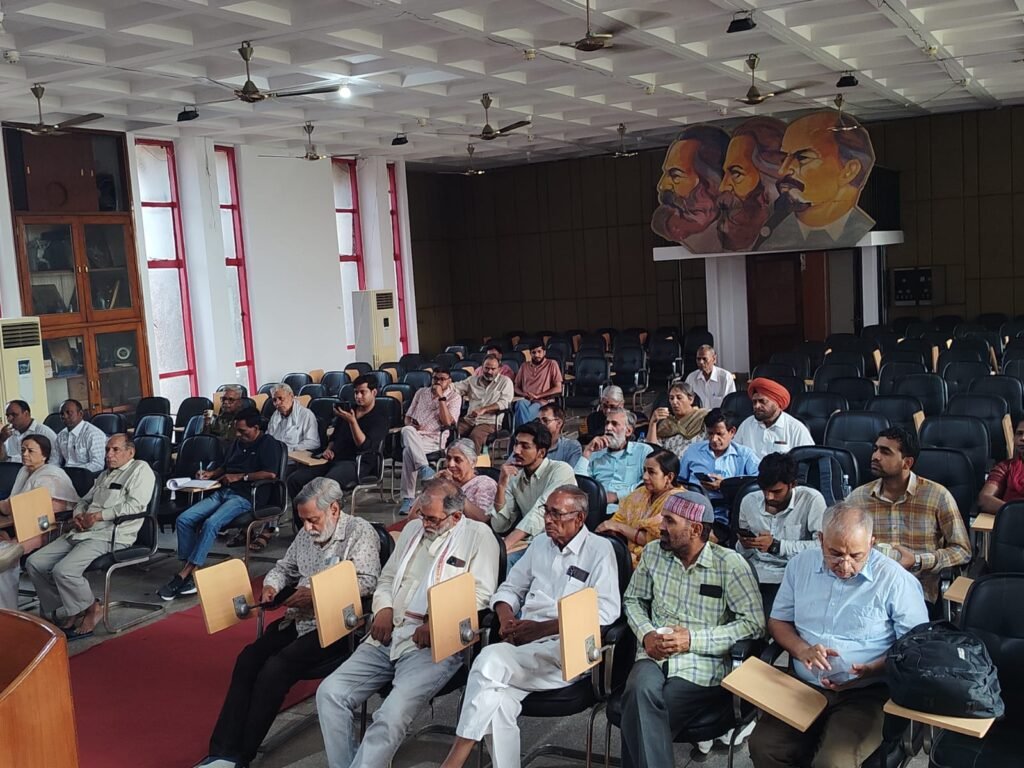
Prof. Patnaik talked about the Non-Alignment Movement, which evolved from Bandung. The Non-Alignment Movement (NAM) was a brilliant movement for strategic autonomy. It was not just a denial of solidarity with the imperialist bloc, but also a platform for mutual development between friendly global South nations. India was one of the leading members in both Bandung and NAM. Prof. Ajay Patnaik talked about the general misconception of considering NAM countries as neutral. He argued that the NAM countries were not joined with any of the blocs, whether it’s the socialist bloc or imperialist bloc, but they were never neutral; most of them were against the imperialist powers. Being a huge strength of more than 120 nations, NAM had an important role in the United Nations. This strategic autonomy played an important role in conserving the sovereignty of nations, which is ironically being compromised in the contemporary world crisis, where the imperialist bloc is pressuring the developing nations through economic sanctions and warfare to align with their policies. Prof. Patnaik added that BRICS has emerged as a supportive system for the Global South.
The lecture was followed by a brief session of questions answers. In the end Dr. Jaya Mehta, the Research and Academic Head of the Joshi-Adhikari Agriculture stated briefly the importance and relevance of the BRICS and Bandung Conference. She said that after the Second World War, the framework of the New Economic Order was established through the Bretton Woods, the IMF, the World Bank and the development of the dollar as the world’s currency. It was said that one is for peace and to save sovereignty. Ironically, even after the establishment of the UN, the Korean War saw US brutality, and China was threatened by the United States with military action. So, the South-South cooperation and global South solidarity acted as an active catalyst against imperialism. Even if this unity is not anti-capitalist, even if it supported the capitalists of their own countries, still, it’s better than supporting imperialist powers in the global context. BRICS has three main areas of Cooperation that are Political and security, economic and financial, cultural, and people-to-people exchange. Now the US has the dollar hegemony benefit. Nearly 67 countries are sanctioned by the US powers. The BRICS, in order to dismantle this hegemony, focused on financial and economic alternatives such as Bilateral trade, alternative financial messaging platforms, alternative trade routes such as China’s Belt and Road Initiative, etc. These small but impactful initiatives are having a significant role in forming a multipolar economic order.
The meeting was attended by important dignitaries like Com. Annie raja, Com. Dr. Bhalchandra Kango, Com. Dr. Girish, Com. Dr. Dinesh Varshney, Com. Rajan Kshirsagar, Com. Venkaiah, Com. Nisha Siddhu, senior journalist Sheeba Aslam Fehmi, author Prof. Bajrang Bihari Tiwari, Dr. Abhay, Rajeev Kumar Shukl, Dr. Tara, Nityanand Gayen, among many others. Vineet Tiwari, the Convenor of JAISS thanked everyone and announced that there would be series of meetings on these developments to make people aware of the BRICS as the decisions taken in these forums have long term implications on the common people of these countries.