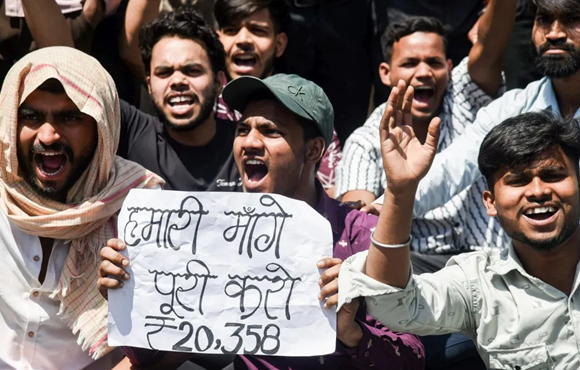
The year 2026 began with labor unrest across the country. Workers, especially contract laborers, in industries located in many states—including Bihar (Barauni), Haryana (Panipat Refinery), Madhya Pradesh (Singrauli), Chhattisgarh (Vedanta in Korba), Andhra Pradesh (UltraTech), and Tamil Nadu—held sit-ins, demonstrations, and strikes demanding higher minimum wages, fixed working hours, double overtime pay, and bonuses. Following this, workers in some industrial companies received assurances or relief, while others were encouraged to intensify their struggle. Subsequently, the issues of wage increases, double overtime pay, fixed working hours, bonuses, and dignity spread to Gurgaon-Manesar in Haryana, Surat in Gujarat, the industrial city of Noida in Uttar Pradesh, and then to Uttarakhand.
In Noida, Gurgaon, and many metropolitan cities, the workers who build massive towers, housing societies, and colonies; manufacture cars and two-wheelers; and produce consumer goods such as clothes, shoes, and mobile phones are the very people who create these products, yet they cannot even dream of consuming them. This is because they do not earn enough wages to afford even a full meal sufficient for a dignified life. Living in slums and shanties, they expend all their capacity and energy merely to secure two meals a day. However, their concerns have now begun to be raised prominently in large and small factories and industrial units across dozens of cities in the country. Workers—especially contract workers and gig workers—are organizing and raising their issues more assertively.
From the first week of April 2026, large labor movements were witnessed among workers in the NCR, along with large-scale joint attacks, baton charges, arson, and arrests by the police administration and henchmen of company managements. In particular, workers faced extensive repression and arrests in Noida. In the corporate media, labor unrest was portrayed—citing the government—as being sponsored by Pakistan and anti-national. In view of this, the civil rights organization “Jan Hastakshep” decided to send a fact-finding team to Noida and Gurgaon-Manesar to comprehensively study the prevailing situation and all the incidents. For this purpose, two separate investigation teams were formed. One team visited Noida on 24 April 2026, and the other visited Gurgaon-Manesar on 17 May 2026. In addition, several labor activists and leaders from Noida and Gurgaon, who had been in jail due to arrests, met the Jan Hastakshep investigation team after being released on bail and provided information about the facts.
Industrial and Workers’ Conditions in Noida–Gurgaon–Manesar
The National Capital Region (Delhi NCR) has, over the past decades, become the country’s largest industrial region with a massive working-class population. Noida and Greater Noida are counted among the largest industrial clusters in North India. There are approximately 15,000 to 20,000 industrial units of various sizes related to automobiles, electronics, mobile phones, garments, automobile parts, IT hardware, construction, warehousing, and export industries, employing around 1.7 million workers. Of these, 300,000 to 500,000 are permanent workers, while 1.0 to 1.2 million are contract workers. The proportion of contract workers exceeds 75 percent. The region includes Sector 63, 64, 65, Phase I Industrial Area, Phase II Industrial Area, Noida Special Economic Zone, Ecotech 1–12, Surajpur Industrial Area, Kasna Industrial Area, and the Greater Noida Industrial Belt. A large number of migrant workers from Uttar Pradesh, Bihar, Jharkhand, West Bengal, Odisha, and Chhattisgarh work here.
According to official figures from the Noida Authority and industry organizations, there are approximately 11,000 industrial units in Noida. Of these, 9,700 units are operational, and around 7,500 are registered under the Factories Act. The number of industrial units located across Noida, Greater Noida, and the Yamuna Expressway region is estimated to be around 15,000. These include industries such as manufacturing, electronics, garments, auto parts, and warehousing. In Noida, a total of 800,000 to 1.2 million workers are employed across industrial and construction sectors. However, during the COVID period, the Labour Department registered only 38,000 construction workers. A large number of workers remain unorganized and work on contract or casual bases without any registration.
The Gurgaon and Manesar region of Haryana is known as one of the country’s largest hubs for automobile, auto parts, garments, electronics, and export-oriented industries. However, different government and industrial sources provide varying figures regarding the number of industries and workers employed there. According to the Haryana Labour Department database, Gurgaon has approximately 20,000 small and large industrial units. These include government industrial areas, private industrial zones, and older industrial clusters. According to industry organizations, IMT Manesar alone has around 3,000 factories. In the unregulated industrial areas of Gurgaon—Daulatabad, Basai, Kadipur, and Behrampur—there are more than 5,000 small and medium industrial units. IMT Manesar alone employs approximately 350,000 to 400,000 workers, of whom more than 100,000 are contract workers. In many factories in Manesar, contract workers form the majority and are hired through various contracting agencies or contractors. Over the past one and a half decades, the proportion of contract workers in the automobile and auto-parts industry has increased rapidly. In most companies, the number of permanent workers has steadily declined relative to contract laborers. According to estimates by Haryana’s industrial organizations and the Labour Department, the Gurgaon–Manesar belt has a total industrial workforce of around 1 million workers, including 300,000 permanent workers and 700,000 contract workers.
The NCR region includes 24 recognized industrial areas, including Gurugram, Manesar, Faridabad, Greater Noida, Noida, Ghaziabad, Bahadurgarh, Naraina, Wazirpur, Mayapuri, Bawana, and Narela. In addition, NCR contains hundreds of industrial cluster areas. Many small industries are not even registered and operate within residential neighborhoods. As a result, labor laws are often not enforced there. Altogether, these thousands of small and large industrial units, along with construction sectors, employ between 8 million and 15 million permanent and temporary workers. However, no official data is available that can accurately state how many industrial units exist or how many workers they employ. Media reports, private studies, and data available on the internet remain the only estimated sources.
A large number of workers in NCR are informal workers because they are recorded on unofficial company registers. They often do not receive essential benefits such as bonuses, EPF, ESI, or leave, and therefore no official government record of them exists. As a result, accurate figures are difficult to obtain. What is clear, however, is that Delhi-NCR has become the country’s largest industrial and labor-population center, where workers are employed under severe exploitation and in inhumane conditions. Over the past two decades, many rights won by industrial workers through struggle and sacrifice have disappeared, and factory workers have become dependent not on companies but on contractors. Following the central government’s replacement of labor laws with four labor codes, conditions have reportedly deteriorated further, contributing to recurring labor unrest not only in Noida and Gurgaon but also in industrial regions across several states of the country.
Members of the Gurgaon-Manesar Fact-Finding Team
• Ish Mishra, former professor, Hindu College (University of Delhi)
• Siddharth, civil rights activist
• Anil Dubey, co-convener, Jan Hastakshep and senior journalist
• Haider Naqvi, senior TV journalist
Facts received by the Jan Hastakshep investigation team
The investigation team found in its study that Gurgaon-Manesar has a history of militant labor movements, but in recent years company owners and the RSS-BJP government have not only eliminated workers’ living minimum wage, but have also taken away their constitutional and legal rights such as forming unions and expressing dissent.
A four-member team from Jan Hastakshep reached Gurgaon on April 17, 2026. The team held detailed discussions with affected workers, labor activists imprisoned in Bhondsi Jail, labor leaders and activists who had been released from jail, and family members of those arrested. Here, the police administration had arrested 44 people in 95 FIRs, including 22 women. They were later released on bail. In addition, 17 people were taken into custody in 94 FIRs. Several of them were kept in Bhondsi Jail under Section 307. On Monday, April 18, the day after the investigation team returned, Ajit Singh, General Secretary of the Bellasonica Union, was granted bail. The remaining individuals were still in jail at the time the report was written, and efforts to secure their bail were ongoing.
The Jan Hastakshep team found during its fact-finding investigation that workers’ discontent had existed for a long time because the Haryana government had not increased the minimum wages of workers and contract laborers for 10 years. Trade unions representing workers in the Gurgaon–Manesar industrial areas had been continuously protesting for wage hikes. Workers had become distressed due to low wages, rapidly rising inflation, and a fourfold increase in gas prices.
In view of workers’ dissatisfaction, the state government formed a committee in 2025 to consider increasing wages. The committee included representatives from company management associations, trade unions, and the labor department. Its final meeting was held in December, where consensus was reached on raising the minimum wage, which was to be implemented from April 1, 2026. Later, the Haryana government amended the committee’s report and, on April 3, agreed to raise the minimum wage to ₹15,220, subsequently issuing a notification on April 8. One noteworthy fact is that during the same period, the Haryana government carried out large-scale administrative transfers in several districts, including Gurgaon and Manesar.
Background of Labor Unrest in Gurgaon–Manesar
On May 17, the Jan Hastakshep fact-finding team was unable to meet Ajit Singh, General Secretary of the Bellsonica Union in Gurgaon, because he was in jail at the time. After his release, the team contacted him on May 28. He explained that in automobile, garment, and other industries in the region, most workers are contract laborers who have been working for 2 to 5 years or more. In garment companies, nearly 100% of the workforce consists of contract workers. Over the past 10 years, the Haryana government has not increased the minimum wage, and workers receive a wage of ₹11,200. No dearness allowance is added to this wage. Moreover, workers do not receive the full amount in hand because companies deduct money in the name of ESI and provident fund, even though, due to their contract status, they receive no medical, insurance, or provident fund benefits. After these deductions, workers take home only about ₹11,000 or even less. He further stated that the categories of skilled, semi-skilled, and highly skilled workers exist largely in name only. Any worker operating machinery should be classified as skilled, but contract workers, despite years of experience working on machines, continue to be treated as unskilled and paid only ₹11,000.
With inflation having risen several times over during the last decade, a worker cannot support a family on ₹11,000 a month. As a result, workers are compelled to work four hours of overtime daily. Although the law requires overtime to be paid at double rates, they are paid only the regular rate for overtime. In addition, when a worker is employed continuously on a permanent basis, they should not be classified as a contract worker, but companies do not follow this rule. According to him, this is because a different kind of governance system now exists within companies. Workers can obtain relief only through unions, but contract workers do not have the right to form unions or join existing ones. Because they lack unions, they are also denied respect in the workplace. Due to the U.S.–Iran war, inflation and gas prices have increased many times over. Most workers live in the villages of Gurgaon and Manesar, in houses for which they pay rent. The same landlords often also run gas and grocery shops, and the workers are compelled to buy from them. This results in a different kind of exploitation.
Beginning of the Gurgaon–Manesar Movement
Ajit Singh explained how the incident began. Contract workers employed at Honda Automobile Company went on strike on April 2, 2026. They had four demands: their wages should be increased from ₹11,000 to ₹20,000, overtime pay should be doubled, a bonus should be paid before Diwali under the Bonus Act, and they should be treated with dignity at their workplaces. When Honda’s contract workers went on strike at the factory gate on April 2, the company formed a five-member committee consisting of representatives from the district administration, company management, labor department, and workers. After negotiations, the committee proposed a wage increase of ₹1,500, which the workers rejected. That night, the workers returned home. When they came back on April 3, the administration prevented them from holding a sit-in at the factory gate. The workers then moved to a park near the tehsil office, where protesters have traditionally gathered. After this, the administration and company management proposed forming another committee and sent their representatives. A two-hour negotiation took place, during which a minimum wage of ₹16,000 was agreed upon. In addition, there was agreement on double overtime pay, payment of bonuses, and an extra allowance for night shifts. Company management also promised that no contract worker who participated in the two-day strike would be dismissed or face any disciplinary action.
He further stated that after this victory for the workers of Honda’s main company, contract workers at Honda’s supplier companies also began protesting. Contract workers at Munjal Showa, which manufactures shock absorbers for Honda, staged a sit-in and raised the same demands. Subsequently, about 1,000 contract workers at Satyam, a vendor company for Hero Automobile, also joined the protest. Contract workers from various companies started gathering at the Manesar tehsil office. On April 5, contract workers from Roop Polymers joined the movement. Then, on April 7, workers from the garment-sector company Richa Global and its subsidiary companies RichaCo and Modelama also arrived at the tehsil headquarters to participate in the sit-in. The contract employees of all these companies were demanding the same concessions that Honda had already approved for its contract workers.
As the movement of contract workers from multiple companies continued to grow, representatives of the district administration, labor department, and company management held ongoing negotiations with the workers. However, during this period, the police administration and company management consistently prevented trade unions and activists working among contract workers from reaching the protest site. No registered trade union was allowed to participate in the negotiations with the workers. They were not even permitted to visit the protest site. On April 7, in addition to Ajit Singh, Shyamveer, Harish, Raju, and Vikas, Akash—a trade union leader associated with the Inquilabi Mazdoor Kendra and himself a contract worker at Munjal Showa—was arrested by the Haryana government’s Crime Investigation Agency (CIA). Four people were arrested from the protest site and two from their homes. After late-night questioning, they were released with a warning: “You people should not be seen in Manesar again.”
He said that the strike by contract workers of several companies in the area continued on April 8 as well. The companies refused to increase wages but said they were willing to discuss overtime. However, on April 8 itself, the Haryana government announced minimum wages of ₹15,200 for unskilled workers and ₹18,000 for skilled workers. The police administration imposed Section 144 across the entire area on April 9. The workers also felt that their demands had been accepted, so they did not come to the protest site either. Contract employees of Richa Global, Modelama Export Company told the company management that since the government had increased wages, the company should put up a notice about the wage increase on the notice board. The management refused to post the notice. Ajit Singh said that immediately afterward, the management called the police, and a brutal baton charge was carried out against the workers sitting at the factory gate. Women were also seriously injured in the baton charge. Incidents of vandalism and arson began in the presence of the police, even though the workers had already fled the area after the baton charge.
He said that at the same time, to condemn the baton-charge incident, he had gone to the Deputy Collector’s office at noon to submit a memorandum. While returning from there, he was arrested. Meanwhile, 30 contract workers, including 10 women, went to the Assistant Labour Commissioner with a complaint about the baton charge. All of them had suffered considerable injuries. After submitting a memorandum to the ALC and while returning, they too were arrested. Ajit Singh said that Harish, Shyamveer, and he were arrested again and taken to the CIA office. At the same time, 11 workers who had also been arrested were brought there. At 11 p.m., he was released after bail was granted for three people. He said that the police conducted raids in the villages and arrested 44 people, including women. Throughout the night, the police created an atmosphere of fear across the entire Industrial Model Township (IMT). On April 12, he and six of his companions were again picked up from their homes and taken to the CIA’s Navurampur police station, and the next day it was publicized in the media that they were the masterminds behind inciting the workers and the violence. He said that out of the 17 workers arrested in 94 FIRs, 15 are still in jail, and they continue their protest along with legal action. There was also a strike in two companies on May 10 because several companies had still not started paying the increased wages. Meanwhile, the Haryana Industrial Chamber of Commerce clearly stated that they could not pay the increased wages.
False cases and difficulty meeting people in jail
Mohinder Kapoor, president of the Maruti vendor company Bellsonica Auto Components India Employees Union, said that the police have arrested some workers on charges of attacking two female constables and have imposed serious sections such as attempted murder against them. However, according to the medical report of the female constables, there is no medical certificate showing any injury or even marks of injury. Kapoor said that relatives can meet people lodged in Bhondsi Jail only if the inmate himself provides details of which family members he wishes to meet to both the relatives and the jail administration. As a result, it is taking a long time for the message to reach the family, and meetings are often not possible. He said that after the police lathi-charge, workers had returned to their homes in villages such as Bhangrola, Naharpur, Bansgaon, and others where they lived. The police entered the villages, beat people, and made arrests.
He said that workers had been dissatisfied for a long time and had continuously demanded wage increases. For this reason, the Haryana government formed a committee on wages in 2025, which included representatives from company management, administrative officials, the labor department, and trade unions. In December, the committee unanimously fixed the minimum wage at ₹23,096. It was supposed to be implemented from April 1, but later the Haryana government reduced it to ₹15,220. The notification for this increase was issued on April 8. He said that if all company owners had displayed notices about the increased wages, contract workers would have felt some relief, whereas Honda had already implemented the wage increase. This significantly increased workers’ dissatisfaction.
Pintu Kumar Yadav, treasurer of the Bellsonica Union, has also been lodged in Bhondsi Jail. His wife, Rukmani, said that on April 12, around midnight, some people in plain clothes came and arrested her husband. During this time, they used abusive language. They did not show any documents related to the arrest. In the morning, when they went to the Sector 7 Manesar police station along with union members, they were again abused and were not given any information. Later, they learned that Pintu Kumar had been kept in the police lines and charged under Section 307 (attempt to murder). On the same night, Ajit Singh and several others were also arrested.
Contract worker Akash’s wife Divya said that her husband was arrested at night. The gate was broken to carry out the arrest, and they entered the house hurling abuses. After that, we called the 100 emergency number, and only the next day did we learn that Akash had been arrested and sent to jail. On April 15, it was with great difficulty that they were able to meet Akash in jail. He has been kept together with inmates imprisoned for other criminal cases. The workers have also not been allowed to receive daily-use items such as soap, oil, toothpaste, etc. from home, and they are being forced to buy all these items from the jail canteen, where they are very expensive. She said that earlier, on April 7, Akash had also been arrested for questioning and was later released on a personal bond. All these arrests were made by the CIA. The Jan Hastakshep fact-finding team was told that the mobile phones and other devices of all the arrested people are still confiscated.
Mahendra Kapoor said that, in the background of the Gurgaon-Manesar movement, workers have been dissatisfied for a long time. Very low wages, failure to pay double overtime, disrespectful treatment at workplaces, rapidly rising inflation, and then a fourfold increase in LPG prices acted as the spark. In response to the investigation team’s question about the state of labor laws there, he said that contract workers do not have the right to form unions, and if any union enrolls them as members, the labor department revokes the union’s recognition on a complaint from company management. He explained that when he began enrolling contract workers in his trade union, the Registrar of Trade Unions sent him a notice, following a complaint from management, instructing him to remove the contract workers or the union’s recognition would be canceled. When he refused to do so, the union’s recognition was revoked and the company management formed a new union. The matter is now pending before the High Court.
In response to a question from the investigation team, he said that a major reason for the widespread dissatisfaction and agitation among workers was also the government’s extensive publicity regarding the four labor codes. The government had widely promoted the four labor codes as being beneficial to workers, claiming that they would increase minimum wages for all categories of workers and double overtime pay. Workers had expected for several months that these provisions would soon be implemented, but companies completely ignored them.
Ajit Singh said that low wages and runaway inflation were the main causes of the movement, and that dissatisfaction still persists. Before the coronavirus pandemic, workers’ conditions were not this bad. In 2019, Bellsonica Company dismissed 450 long-serving workers. Honda also laid off more than 2,000 contract workers citing an economic slowdown, even though all of them had been working there for nearly 10 years. When they began staging protests, the issue was settled at the negotiating table by paying the workers some compensation. He said that those workers had been earning salaries ranging from ₹15,000 to ₹30,000. At that time they also had a union. However, after the pandemic ended, when companies hired new workers on contract, they started paying them only ₹11,000.
He explained that this trend has also begun in companies in other industries. Contract workers cannot join unions because they come through contractors. Company management pressures unions not to make contract workers their members. Most companies have unions, but contract workers cannot become members, and the major recognized trade unions remain silent on issues concerning contract workers. The smaller trade unions that dared to make contract workers members had their recognition revoked. The trade union of Bellsonica Company is a major example of this. When it made contract workers members, the company got its recognition cancelled by filing a complaint with the labor office (the Trade Union Registrar), and then the company facilitated the formation of a new union.
He said that under the Trade Unions Act, 1926, any union is registered. In it, workers are not categorized as contract, permanent, skilled, or semi-skilled. They are simply workers. But now, through collusion between the labor department and company managers, they are changing the very definitions of trade unions and workers. Similarly, a contract worker also works on machines, so they should be considered skilled, but even after working for years, they remain classified as unskilled contract workers. Ajit Singh explained that the term “contract worker” first appeared in 1970 in the Contract Labour Regulation Act. At that time, the government argued that it was being introduced to ensure proper implementation of minimum wage rules and organized payment arrangements for workers brought in from outside for temporary kinds of work, such as painting, whitewashing, or other construction-related tasks in companies. After the economic liberalization policies introduced in 1990 were implemented, companies began applying it to jobs directly related to their entire production processes and established a contract labor system. For workers, this was the biggest blow resulting from the new economic policies and globalization.
—————————-
Members of the Jan Hastakshep Noida Fact-Finding Team
• S.S. Nehra, Senior Advocate, Supreme Court
• Ashok Sharma, Former Foreign Service Officer
• Ish Mishra, Former Professor, Hindu College (DU)
• Anil Dubey, Co-convenor, Jan Hastakshep, and Senior Journalist
• M.Z. Ali, Senior Advocate
The Jan Hastakshep investigation team reached the affected areas in Noida on April 13, 2026, the 11th day after the incident involving workers’ anger and the subsequent police repression. The team attempted to contact all stakeholders connected with the workers’ movement. However, our discussions were primarily with the workers themselves, as meetings with the company management and the administration could not be arranged despite repeated efforts. The team also visited the workers’ workplaces and residential areas, which brought many new aspects to light. These included the low wages workers receive, the disrespect they face at workplaces, and issues relating to social, educational, and health security (particularly for women workers), as well as rest hours. We also examined the workers’ living conditions. Their housing in Noida is located in colonies built in nearby villages and in the flood-prone areas of the Hindon River, which would more appropriately be described as slums. Typically, an entire family lives in a single room. Alternatively, 5–7 workers live, eat, and carry out their daily lives in an 8-by-10-foot room.
The team has tried to understand the workers’ outburst of discontent in Noida in light of these facts. For the past 15–20 years, workers have been employed at wages of only ₹10,000–11,000 per month. The report examines how dissatisfaction had been building among workers over the decades and how, following their protests, the Uttar Pradesh government announced a 21% increase in the minimum wage effective from April 1, 2026. While this increase appears significant in percentage terms, it is quite modest in actual rupee value. Under the revised rates, the monthly wages in Noida have been fixed at ₹13,690 for unskilled workers, ₹15,059 for semi-skilled workers, and ₹16,864 for skilled workers. In the face of rapidly rising inflation, even this nominal increase raises the question of whether companies will actually implement it. The government has not yet made any announcement on how it will ensure compliance. However, the investigation team was later informed that the increase had been implemented in most companies, although some companies have never adhered to minimum wage regulations. Even so, this increase is like a drop of water on a hot griddle, and workers remain dissatisfied. Their demand is for a minimum monthly wage of ₹20,000.
Origins and Facts of the Noida Workers’ Movement
The team found that after large-scale police action and the arrest of around 1,000 women and men, they and their family members were harassed and humiliated for several days. After this, all but about 100 of them were released. Even 11 days after the incident, large numbers of police personnel remained deployed throughout the area, in markets, workers’ residential neighborhoods, and around companies. This created fear among workers, and they were hesitant to speak with the investigation team. Moreover, the administrative officials whom the team wished to interview refused to meet or talk. They even objected to any mention in the report that attempts had been made to meet them. According to them, orders had come from “above” that no one should discuss anything related to the workers’ movement. Considering this atmosphere of fear among workers, their family members, and administrative officials, as well as the alleged terror imposed from higher authorities, the Jan Hastakshep team unanimously decided that its report on Noida would not disclose the real names or occupations of any workers, their relatives, administrative officials, or witnesses to the incident. Therefore, all names appearing later in the report have been changed in accordance with the wishes of the individuals concerned.
A worker from Baliya named Ratanlal, employed at a company, told the Jan Hastakshep team that there are many companies here in which only the owner officially exists. Companies pay contractors by cheque, and the contractors then pay workers from their own accounts. As a result, the companies do not provide salary slips or appointment letters. Even attendance registers are maintained informally. Explaining how the incident began, he said that Richa Global Garments, a company that manufactures sportswear and clothing, also has branches and subsidiary companies in Gurgaon. It opened a branch in Noida Sector 83 as well. The wages it pays in Haryana are not paid in Noida. Employees had already been dissatisfied with this situation, questioning why the same company paid different wages at locations only a few kilometers apart. At the same time, news of labor movements and wage increases in Gurgaon-Manesar was reaching Noida. After receiving their salaries on 9 April 2026, employees began a sit-in protest at the company gate. The police then erected barricades at the company gate and on nearby roads, causing traffic congestion. This created considerable inconvenience for the general public.
Ratanlal said that on Monday the 13th, ordinary people who had been stuck in a traffic jam on the road since morning began protesting against the police blocking the route. This created a chaotic situation, and the police used force. The common people trapped in the jam also ran toward the company gate. This caused a stampede among the workers sitting in protest. After that, the situation became uncontrollable. It is worth noting that this is the same Richa company that was accused in 2020 of refusing to employ Muslim workers. At that time, this news was published by The Hindu and other newspapers. He further said that the company had already had some of the protesting workers arrested on the 10th. This had also angered the workers. According to him, over the past 10–15 years, Noida has become a hub for cheap labor. Many companies from Delhi, Gurgaon, and Rajasthan have moved here and are getting work done by contract laborers at very low wages.
Another female worker employed in a garment and export unit, Anita Maurya, said that when news arrived on the 9th that a garment company in Manesar had given employees higher wages, dissatisfaction spread among workers here, especially those employed in garment and export-related companies. They demanded that management pay wages at the increased rate. She said that there are factories in Noida that were previously located in Delhi and that when the Sheila Dikshit government implemented a 35% wage increase in 2010, many companies shifted to Noida. As long as those companies were in Delhi, they paid the higher wages, but after moving to Noida they cut wages. Moreover, companies often employ people for nine months, then dismiss them for a few days and hire them again. When rehiring them, wages are reduced even further, and workers continue working out of necessity.
When asked what effect inflation has had, she responded with a counterquestion: what would you do if your salary did not increase for 10–15 years, or increased by only 100–200 rupees? Meanwhile, house rent and gas prices have risen several times over. Her husband also works in a factory. Anita Maurya was met at a tea stall. Her mother runs a small roadside eatery selling bread and vegetables on the pavement. Workers who live alone get their daily meals packed from her. Anita’s mother, Rajlakshmi Maurya, said that this small hotel/eatery is what supports their household. Another daughter, after passing intermediate school, now helps her at the eatery because financial hardship prevents her from continuing her education. She said that the condition of workers is miserable and their capacity to endure has diminished. That is why people have come out onto the streets. The police have also harassed them a great deal, yet people are not afraid.
Rajveer, who works for a multinational company and is a trade union leader, said that 20 years ago there was hardly any question of wages in Noida and Greater Noida because workers here earned more than workers in other states. The contract labor system did not exist. Referring to Denso Company, he said that even technicians there earned salaries close to ₹100,000 per month. Similarly, Asian Paints and many other companies paid wages higher than the statutory minimum. He explained that after 1995 and then especially after 2000, rapid changes occurred. Wages started declining, and later demonetization, GST, and the COVID period caused industries to stagnate, leading to reduced worker incomes. He said that now the contract labor system has become dominant. Many companies from Delhi, Haryana, and Rajasthan have come here and do not hire regular employees, instead relying on contract workers supplied through contractors. Since 2004–05, jobs such as housekeeping, canteen work, driving, and storekeeping have increasingly been outsourced to contractors, who pay workers only ₹10,000–15,000 per month. According to him, these wages have remained largely unchanged for the past 20 years. Similarly, production units also increasingly began relying on contract labor.
Workers sitting at a tea stall said that the issue began in garment and export factories before spreading to electronics, manufacturing, packaging, and supply-chain units. They said that the first strike in Noida took place at Richa Company, and it was from this garment company that a worker named Vinay was arrested on April 9. He was later released, but after a large-scale demonstration on the 13th, he was arrested again. The workers said that a wave of protest spread among factory workers in Noida’s Sectors 2, 59, 60, 62, 83, and 84. Nagendra, who had come from Baliya to work here, said that in many places the unrest occurred with the collusion of company owners, managers, and the police. Even in factories or companies where there had been no disputes, the police were called in and began using force against workers. It seemed as though all companies wanted to teach workers a lesson. As a result, the situation deteriorated further. He explained that in most garment-export units in Noida, workers are employed under the contract labor system and are officially employees of the contractors.
Mahavir Singh, who runs a tea-and-snacks shop, said that what started at Richa Company eventually reached Motherson Group, an auto-parts manufacturer, becoming a major trigger point because it employs a very large number of contract workers. Companies where no protests were taking place also pushed their employees onto the streets. Even owners of companies where there was no unrest had some workers arrested by calling the police. This angered workers, and soon 30,000–40,000 laborers could be seen on the streets of Noida. He said that the workers’ slogans included demands such as: “Give us a living wage,” “End the contract labor system,” “Make us permanent employees,” “Equal pay for equal work for women,” “Implement 8-hour shifts,” “Double overtime pay,” “Provide PF and ESI benefits,” “Ensure protection against accidents and illness,” “Guarantee job security and stop arbitrary layoffs,” “Allow freedom to form unions,” and “Increase wages in line with inflation.” Mahavir, who came from Jaunpur years ago, said, “Brother, their condition is very bad. I see them day and night. They struggle for every single rupee. Life runs on credit.”
Another worker sitting there, Sitaram, was asked whether he was happy now that wages had increased. He replied, “What difference will an increase of two or three thousand rupees make? The price of cooking gas has gone up fourfold.” He said that while the government had announced a wage increase, workers still had not received any notice or information from their companies confirming that they would actually get it. Some companies had posted notices about increased wages, but most had not. Therefore, all employees were waiting for their next paycheck. He said that a living wage should be ₹30,000 per month. There is hardly any worker’s family here in which two or three members are not employed. Usually the husband, wife, or children work. Children often cannot continue their education. Instead of paying expensive school fees, most families put their children to work before they turn 18. In such circumstances, even if wages rise from ₹10,000–11,000 to ₹13,000 or ₹16,000, it will not bring real relief. He said this is why workers take double shifts or overtime, yet they are not paid double rates; they earn only about ₹5,000–6,000 extra. Now, even if wages increase by two or three thousand rupees, there is talk of ending overtime opportunities. If that happens, workers’ conditions will become even worse. He said that if wages were ₹30,000, there would be no need for overtime at all.
Conclusion of the Jan Hastakshep Investigation Team
- The Jan Hastakshep fact-finding team attempted to speak with administrative officials in Noida, but they were unwilling to do so. One jail official accidentally met with the team but requested that the interaction not be mentioned in the report. According to information currently available from various sources, the situation is that the police had sent around 1,000 people to jail under Sections 107 and 151 for disturbing the peace, and after considerable harassment, they were released. Slightly fewer than 100 people are still imprisoned in Kasna Jail in Gautam Buddha Nagar. Most of them are trade union activists, supportive students, journalists, or individuals who were seen in CCTV footage during acts of vandalism, or whose names were included in lists of workers provided to the police by company managers. All of them have been arrested under various charges, including assault on police, damage to property, arson, attempted murder, and possession of explosives. Most notably, there appear to be no media reports concerning the police personnel who were allegedly injured, despite workers being charged under serious sections such as Section 307 (attempted murder). After being released from jail, one worker stated that they had been housed with regular inmates and that, at the administration’s behest, other prisoners physically assaulted and mistreated them.
- The brutal manner in which the police crushed worker unrest in Noida, Gurgaon, and Manesar is a major example of states turning into “police states.” Although the Uttar Pradesh Police has previously displayed a similar attitude toward minorities and Dalits, this time the same approach was directed not at religion, caste, or community, but against workers. Following orders allegedly received from “higher authorities,” even women, men, and children passing on the streets were not spared. According to media reports, a 14-year-old child was sent to jail. The police reportedly did not consider whether someone was ill and heading to a hospital or simply returning home with household goods; such individuals were also arrested. Many such examples appear in fact-finding reports prepared by lawyers, journalists, and social activists.
- Beyond Noida, Gurgaon, and Manesar, labor movements that have emerged in other states over recent months have broken the stagnation that had characterized the workers’ movement for years. Demands for higher minimum wages, limiting work hours to eight per day, doubling overtime pay, providing bonuses, and ensuring dignified treatment in workplaces have taken on an all-India character. Wherever worker unrest has erupted—not only in Uttar Pradesh and Haryana but also in other states—the same four major demands have appeared. In the race to become a “Vishwaguru” and the world’s “third-largest economy,” the internal conditions, exploitation, and hardship faced by the country’s workers have drawn attention not only within India but globally. Economic liberalization did create a very limited rise of the middle class, but after 2004 the condition of workers steadily worsened. Since the RSS-BJP government came to power at the center in 2014, the situation has deteriorated further. Demonetization, GST, and then the COVID-19 pandemic hit the working class the hardest. The large-scale migration of migrant workers from cities across the country during the pandemic reflected their helplessness, and the current explosion of labor movements reflects their anger.
- In Noida, the government suppressed the protests in an extraordinary manner and attempted to discredit them, as was done with the farmers’ movement, by portraying them as Pakistan-sponsored. In doing so, it minimized and downplayed workers’ problems, even though this unrest represents the peak eruption of dissatisfaction that has been building for years within India’s industrial economy. The movement demonstrates that the current economy—particularly in Gurgaon, Manesar, and Noida, where production is largely export-oriented—relies heavily on contract workers and employees. The vast manufacturing corridor spanning Noida, Gurgaon, and Manesar includes electronics assembly plants, garment export units, pharmaceutical industries, shoe factories, automobile manufacturers and ancillary companies, as well as mobile phone manufacturing and assembly units, most of which are export-oriented. The glitter and prosperity of cities such as Noida and Gurgaon are built upon the exploited labor of contract workers in these units and construction workers in the unorganized sector. The towering skyscrapers, multiplexes, multinational corporate towers, dazzling malls, and grand buildings of these metropolitan cities stand proudly on the exploitation and sweat of millions of migrant workers from Bihar, eastern Uttar Pradesh, Jharkhand, West Bengal, Odisha, Assam, Madhya Pradesh, Rajasthan, and other underdeveloped regions.
- Even after backbreaking labor, workers here do not earn a living wage, receiving only ₹10,000–13,000. The 8-hour shift exists only on paper; workers typically have to work 10–12 hours. Working overtime (double shifts) is practically mandatory, and the payment for it is arbitrary. Workers living in small accommodations or shanties built by contractors or village strongmen in villages or open areas are compelled to buy food, daily necessities, and small gas cylinders—and get them refilled—from grocery shops run by the landlords, their relatives, or their families. This is the reality for workers in villages around Gurgaon-Manesar. After coming from their villages in search of jobs, workers often become trapped in a severe cycle of exploitation through debts incurred from renting rooms and purchasing food and necessities on credit. As a result, it becomes impossible for them to send a fixed amount of money home every month—the very reason they left their villages and families. Contract workers do not have written contracts. They lack social security and protection, and most are not even entitled to paid leave.
- The immediate cause of workers’ discontent in Noida came from the neighboring state of Haryana. Due to continuous protests by workers in industrial areas such as Gurgaon and Manesar and movements demanding wage increases, the Haryana government announced a wage hike, and some companies implemented it. This news spread rapidly among workers in Noida and Greater Noida, leading to large-scale protests. Gurgaon, Manesar, Faridabad, Noida, and Greater Noida all fall within the NCR region. Workers felt that the same work should not be paid differently in textile, automobile, and other industrial units located only a few kilometers apart. This motivated them to protest, but the role of company managements and the administration in turning their unity and protest into violence is clearly evident.
- The manner in which governments, especially the Uttar Pradesh administration, dealt with the workers’ movement in NCR and the severity with which state power was used is a matter of grave concern for any civil society. Without understanding the seriousness of the issue, the government portrayed it as anti-national and part of an international conspiracy. District, police, and jail administrations even prevented independent media, lawyers, and civil society activists from meeting those involved. Police and district authorities repeatedly claimed that external forces were behind the workers’ unrest. Chief Minister Yogi Adityanath publicly stated that the state was progressing on the path of peace and development, but outside conspirators were trying to create instability in industrial areas by spreading disorder.
- During the workers’ march, police brutally baton-charged not only male workers but also women. After being released from jail, some workers reported that they were beaten in prison following their arrest and housed with ordinary inmates, who allegedly mistreated them at the administration’s behest. The fact-finding team received several reports from various sources regarding the mistreatment of arrested workers in Noida jail. Due to the atmosphere of fear, those sources are not being disclosed in the report.
- More than 1,000 people were arrested in Noida, and just under 100 people still remain in jail, including worker-supporting activists, journalists, students, and workers. Extremely serious charges have been filed against them to prevent their quick release on bail. Satyam Verma, formerly a journalist in Delhi and currently residing in Lucknow, has published a compilation of Bhagat Singh’s complete writings and translated numerous world-famous books. He is also an author himself. The National Security Act (NSA), a draconian law, has been imposed on him. Student Aakriti Chaudhary has also been charged under the NSA. These individuals are being described as members of the Bigul Mazdoor Dasta. Notably, Bigul Mazdoor Dasta is not a banned organization. Claiming him to be the mastermind of the Noida movement, police arrested Satyam Verma from Lucknow, while his supporters on social media say that he has not visited Noida in the past decade.
- The major workers’ protest march in Noida took place on April 13, and on the same day violent incidents occurred due to a conspiracy involving the police and company managers, according to some eyewitnesses cited in the report. On April 14, only scattered protests occurred, but on April 23, through alleged collusion between the police and company managements, FIRs were filed against many unidentified individuals, and arrests are still being made under those cases. Police are targeting student leaders, journalists, and social activists so that no one speaks in support of the workers. Yogesh Meena, a student leader who had contested the Delhi University Students’ Union election, was arrested one and a half months after the Noida workers’ march. This is clearly an open violation of people’s constitutionally guaranteed freedom of expression and democratic right to protest.
- Two workers associated with Richa Global, Karim and Akash Saxena, were arrested recently—almost two months after the incident—and charged under serious sections of the law. Even after April 13, both workers continued working at Richa Global until their arrest. It is known that the FIR was filed by Richa Global’s HR management several days after April 13. The arrest of these workers under serious charges two months after the incident, at the behest of company management, is deeply concerning and repressive. Workers and their supporters who participated in the massive peaceful march on April 13 have been charged with offenses such as arson, attempted murder, and possession of explosive substances, apparently to ensure they do not receive bail quickly. The police produced everyone before the court, but a charge sheet has still not been filed.
- Nearly two months after April 13, when the fact-finding team contacted some workers in Noida, it learned that workers who had left Noida and returned to their villages out of fear of police repression or company management had still not returned to work. Even among those who did return, many could not regain employment in the companies where they had previously worked. Similarly, although most companies have implemented the minimum wage increase announced by the Uttar Pradesh government, many companies still have not. There has been no mention in the media, nor confirmation through medical reports, of alleged attacks on police personnel and injuries to them in Gurgaon, Manesar, and Noida.
Demands of the Fact-Finding Team
Considering the current condition of workers in the NCR, the Jan Hastakshep Fact-Finding Team has concluded that the governments of Uttar Pradesh and Haryana should immediately accept the workers’ demands, which are as follows:
- All cases against workers related to the labor movement should be withdrawn immediately, and all arrested persons should be released.
- Allegations of mistreatment and assault of workers in Noida jail should be investigated, and confiscated mobile phones and other devices should be returned.
- The government should ensure payment of the promised wage increase with effect from April 1.
- The workers’ four major demands—a living wage, an 8-hour workday, double payment for overtime, annual bonuses, and dignified treatment at workplaces—are democratic and constitutional rights. Therefore, the government should take appropriate action to implement them.
- The contract labor system should be completely abolished, and companies should hire workers directly.
- The four anti-worker labor codes should be immediately repealed, and labor laws and labor rights, including the right to form unions, should be fully implemented.
- A comprehensive record of all small and large industrial units in Noida, Gurgaon, and Manesar should be compiled, and a register of workers employed there should be maintained.
- Workers should be paid a living wage, and wage increases should be linked to inflation. Their PF and ESI cards should also be ensured.
Convenor
Dr. Vikas Bajpai (Jawaharlal Nehru University), 9717 820427
Co-Convenor
Anil Dubey (Senior Journalist), 98110 80915