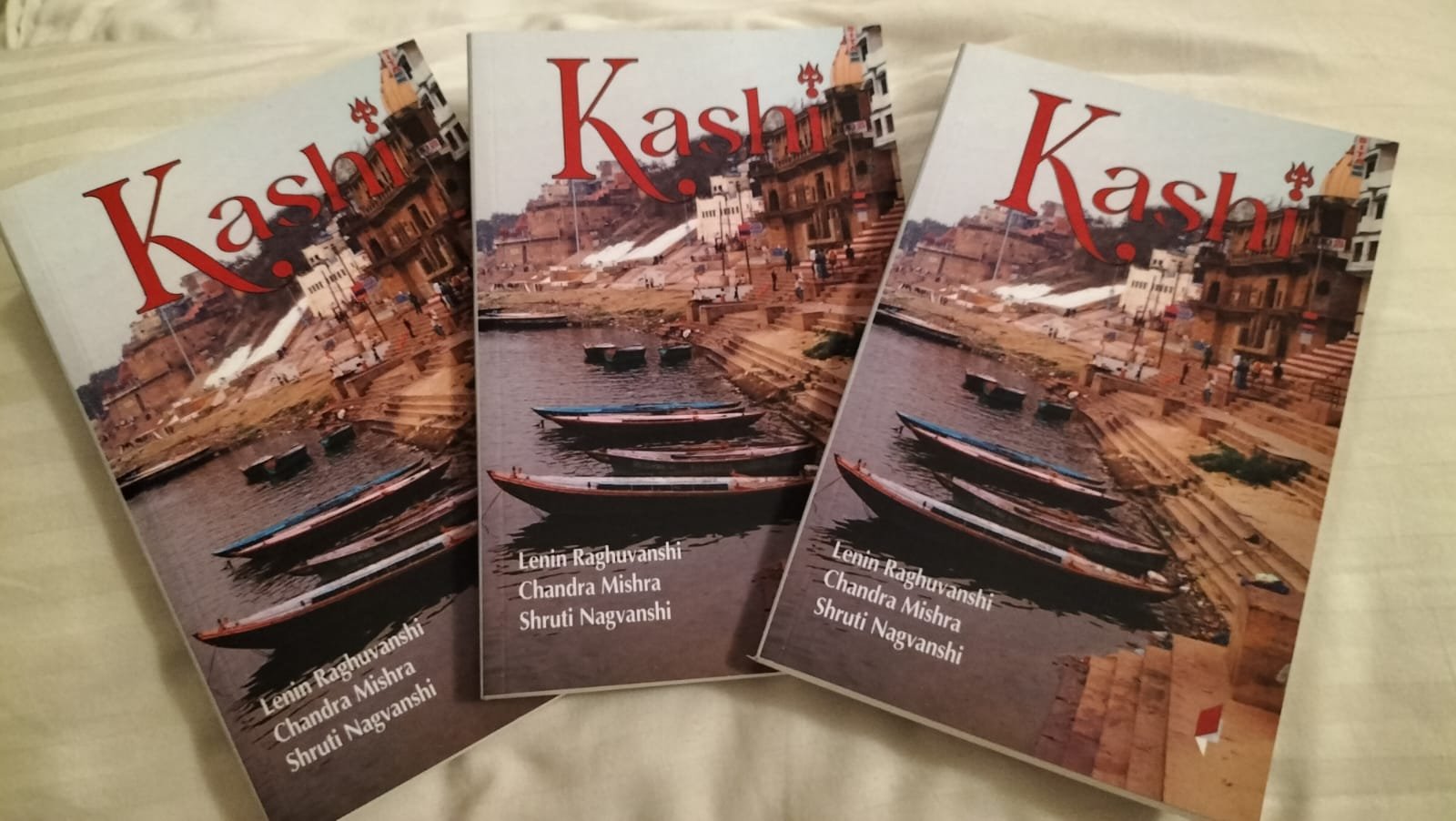
In a civilizational landscape as symbolically saturated as Kashi, any new book risks either repetition or reverence. This work, however, by Lenin Raghuvanshi, Chandra Mishra, and Shruti Nagvanshi, attempts something more ambitious—it reclaims Kashi not merely as a sacred geography but as a living, contested, and deeply human space. The authors, each bringing a rich background in journalism, social activism, and human rights engagement, lend the narrative both intellectual depth and experiential authenticity. Moving beyond the familiar tropes of ghats, temples, and transcendence, they foreground what may be called a “people’s Kashi,” where spirituality is inseparable from questions of dignity, labour, and social justice. This shift in perspective is perhaps the book’s most compelling achievement.
From the outset, the text challenges the reduction of Kashi into a spectacle of faith or a tourist postcard. Instead, it insists on seeing the city through its invisible custodians—Dalits, weavers, sanitation workers, widows, and marginalised communities whose labour sustains the very aura that is celebrated globally. As the opening chapters suggest, Kashi is not just “older than history,” but also urgently contemporary, standing at a crossroads shaped by development, commodification, and exclusion. This framing is both politically sharp and philosophically grounded, offering a narrative that is at once critical and empathetic.
What makes this work particularly noteworthy is its conceptual lens. Rather than treating spirituality as an abstract or escapist domain, the book reinterprets it as a site of resistance. The figure of Mahadev, for instance, is not invoked merely as a deity but as a philosophical archetype of dissent—one who dismantles hierarchies and stands with the marginalised. This reading is refreshing and intellectually generative, especially in a time when religious discourse is often co-opted by power structures. The authors succeed in reclaiming tradition as a radical, egalitarian force rather than a conservative one.
Equally striking is the book’s engagement with exclusion—not as an incidental flaw but as a structural condition embedded in everyday life. The discussion of caste, gender, and economic marginalisation is detailed and unflinching, yet it avoids slipping into despair. Instead, it balances critique with narratives of resistance, such as grassroots interventions and community leadership, which suggest that transformation is not only necessary but possible. This dialectic between exclusion and agency gives the book its moral and analytical depth.
Another significant contribution lies in the way the book situates Kashi within a broader civilizational and global context. It asks questions that resonate far beyond the city: how does one modernise without erasing memory? How does one preserve heritage without commodifying it? In this sense, Kashi becomes a metaphor for all ancient cities negotiating the pressures of modernity. This universalisation of a local narrative is handled with nuance, making the book relevant to an international readership.
Yet, for all its strengths, the book is not without limitations. At times, its strong normative stance—particularly its emphasis on resistance and marginality—tends to overshadow other dimensions of Kashi’s complexity, leaving the aesthetic, artistic, and everyday cultural life of the city relatively underexplored. While the book offers a compelling reorientation of Kashi, a more nuanced engagement with the city’s internal contradictions—beyond the binary of spectacle and suffering—would have deepened its analytical reach. For instance, the recent transformation around the Kashi Vishwanath Corridor reveals a layered tension between heritage-led development and the displacement of long-standing local communities, while the global prestige of Banarasi silk stands in stark contrast to the precarious conditions of the weavers who sustain this legacy.
The domain of music offers another telling example. The celebrated classical traditions of Kashi—often projected as markers of civilizational grandeur—coexist with rich, living folk expressions rooted in the city’s narrow lanes, working-class neighbourhoods, and everyday cultural practices. A more deliberate juxtaposition of these parallel musical worlds could have revealed how cultural prestige and cultural invisibility coexist within the same urban space.
At another level, the book could have more critically engaged with the transformation of Kashi’s spatial identity. Traditionally imagined as a self-contained sacred city—symbolically situated on the trident of Shiva and defined by its inward civilizational coherence—Kashi has long carried a certain pride in its limits. However, contemporary development, driven by expansion and infrastructure, is steadily absorbing surrounding villages, fields, and peripheral settlements. This process is reshaping not only the city’s geography but its underlying cultural logic. A deeper reflection on this shift—from a bounded sacred space to an expanding urban formation—would have added a vital dimension to the book’s inquiry.
While the philosophical framing remains one of the book’s key strengths, it occasionally leans towards idealisation. A more critical engagement with how spiritual traditions have also been historically shaped by structures of power would have made the argument more rigorous.
Despite these minor reservations, the book stands out as a significant and timely intervention. Its greatest achievement lies in its refusal to romanticise Kashi while still preserving its ethical and spiritual core. By shifting the gaze from monuments to people, from spectacle to substance, it opens up a new way of seeing one of the world’s oldest cities. It reminds us that the true light of Kashi does not reside in its architecture or rituals alone, but in the resilience, dignity, and silent struggles of those who inhabit it.
In doing so, the book not only reimagines Kashi but also redefines what it means to write about a city—transforming description into dialogue, and observation into a form of ethical inquiry.

Vijayshankar Chaturvedi is a noted Hindi poet, senior journalist, and public intellectual whose work explores the intersections of literature, politics, and society. Born in Madhya Pradesh, he has contributed extensively to leading newspapers, magazines, television, and digital platforms. He is the author of the novel Vidushak and the poetry collection Prithvi Ke Liye To Ruko. Chaturvedi has also edited significant volumes engaging with contemporary social concerns. In the age of AI, he has proposed the philosophy of Sachet Viramvad—the “Deliberative Agency Theory”—currently under international peer review. He continues to write on public policy, human consciousness, and the evolving nature of agency.