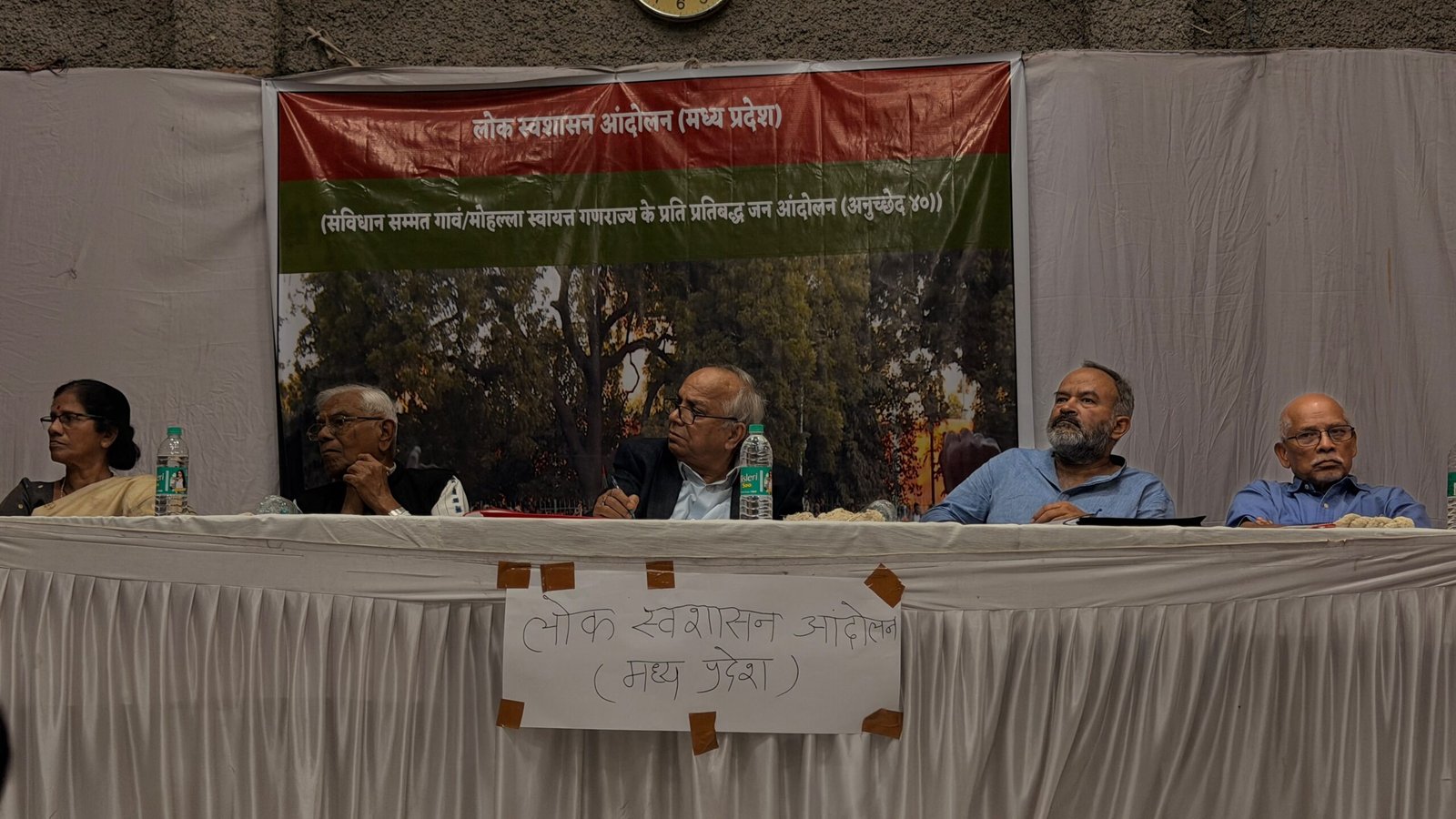
On November 12, 2026, the Lok Swashasan Andolan organized a one-day public hearing at Gandhi Bhavan in Bhopal to review the implementation and violations of the Forest Rights Act in Madhya Pradesh. More than 500 tribal and forest-dependent communities from approximately 35 districts and their grassroots organizations participated in the public hearing, testified and presented their issues on the forest rights violations, supported by evidence. The five-member jury comprised Justice A.K. Patnaik, retired Supreme Court Justice; Professor Virginius Xaxa, retired Tata Institute of Social Sciences; Mr. Sharad Chandra Behar, former Chief Secretary of Madhya Pradesh; Ms. Kusum Alam, poet and social activist, Maharashtra; and Mr. Vineet Tiwari, poet, journalist, and playwright, editor of the progressive magazine Vasudha and national secretary of the Progressive Writers’ Association.
2026 marks the 20th anniversary of the Forest Rights Act, which was passed by Parliament in 2006. The Forest Rights Act, came into force in 2006 after a long struggle by tribal and forest-dependent organizations and widespread grassroots struggle, is a transformative legislation aimed at redressing the historical injustices suffered by tribals and other forest-dependent people during the colonial and post-independence eras. To establish democratic governance in forests, the Act shifts authority for the governance, management, and conservation of forests, forest resources, wildlife, and biodiversity from the Forest Department to village-level ” Gram Sabhas” and empowers the rights holders. The Act establishes a four-tier statutory framework , recognizing and vesting various forest rights; applying to all types of forest land; giving protection to the rights; and establishing a comprehensive claims process and evidence framework for recognizing rights.
Contrary to government reports and statistics, the public hearing reveals that in Madhya Pradesh, a tribal-dominated state with the largest forest area, this law has not been duly and properly implemented for the past 20 years. In fact, the bureaucratic apparatus controlled by the forest department is continuously trying to weaken, obstruct, and render it ineffective. The participants’ testimony in the public hearing revealed how historical injustice continues to be perpetrated against forest-dependent and tribal communities. In almost every district, incidents of forced evictions, demolitions of homes, burning of crops, spraying of pesticides on crops, and filing of false cases by the forest department were reported. Even those claimants who received title deeds have been issued eviction notices by the Forest Department. People submitted that no matter how many times they cite the Forest Rights Act, the Forest Department refuses to comply with it.
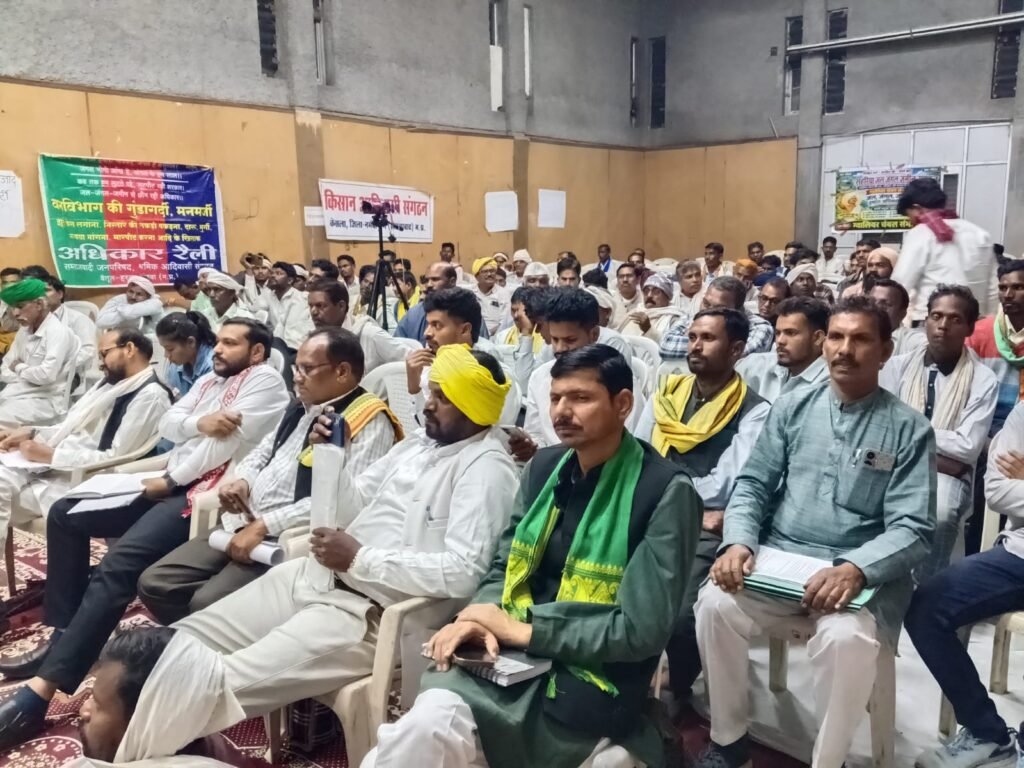
Sahariya tribals said that the structure for implementing the Forest Rights Act in the Gwalior-Chambal division has been absent and non-operational for the past 20 years. Gram Sabha has been deliberately limited to the Panchayat level, and the Forest Rights Committee has been formed by the Panchayat or officials, with everyone from the Patwari to the Beat Guard as its members. Information about these committees is not even available at the subdivision level. The subdivision-level committee itself consists of 8-9 members, and even their meetings are not held regularly. No information, training, or documentation has been provided for the past 20 years—even today, Sahariyas are deprived of forest rights.
Participants testified about the status of the individual forest rights claim process, stating that a large number of claims remain pending, are being rejected without any reason given, and claimants are not even given any written notice nor are they given an opportunity to be heard. Many claims are being rejected against the law, arbitrarily, or for illegal reasons – such as on the basis of satellite *, name not being in the encroachment list, lack of fine receipt, claims on *disputed land (disputed/orange area in the accounts of the Revenue and Forest Departments).
In 2019, the state government launched the Van Mitra Portal in the name of establishing transparency, accountability, and a streamlined process for reviewing rejected claims. However, the situation on the ground reveals how this portal has become a means of rejecting claims. The Van Mitra Portal is largely operated by kiosk operators and Panchayat secretaries. The Gram Sabha-based democratic claims process has been replaced by a mechanical, administrative system, and today claimants are unable to check the status of their own claims. Claims previously rejected are again falling victim to these technical errors and procedural inadequacies, being wrongly rejected again without justification.
Residents of Dindori explained how satellites are being used in the process of converting forest villages into revenue villages. Instead of the Gram Sabha, the Forest Department is conducting this rights process through a top-down process. Wherever this process has occurred, forest villages have been demarcated incorrectly, a smaller area has been included, and the Gram Sabha has been completely bypassed. Villagers are only learning about forest villages being converted into revenue villages through the news. Meanwhile, three PVTG communities exist in Madhya Pradesh, but their habitat rights process remains nonexistent, even though the law mandates district-level committees to assist in ensuring the habitat rights of these communities, such as the Baiga, Saharia, and Bharia.
The situation regarding Community Forest Resource Rights claims, which provide the right to protect, manage, and maintain community forest resources, and which, in conjunction with Section 5, empowers the Gram Sabha for democratic governance and management, and to make decisions to protect its forest area from destructive activities, is even more concerning. Committees at the subdivision and district levels are not approving Community Forest Resource Rights claims. The Forest Department itself is creating the most significant obstruction, as evidenced by the fact that the PCCF Bhopal recently issued a letter restricting and misinterpreting Community Forest Resource Rights, despite not having the authority to do so.
While the Gram Sabha’s right and authority on conservation is being violated, the state government is continuously expanding protected areas such as tiger reserves, sanctuaries, conservation reserves, and corridors in the name of conservation. This conservation approach, based on the fortress model, is resulting in the violation of the rights of a large number of forest-dependent people, their forced criminalization, the rejection of their claims, and their displacement. Residents from Ratapani, Panna, Durgawati, Kanha, Harda, Satpura, Hoshangabad, Satpura, Kalda mountain region, and other areas described how they are being displaced in the name of conservation, despite having coexisted with wildlife for centuries. The Wildlife Protection Act emphasizes the recognition of rights, yet even today, the notification of tiger reserves is being imposed from above.
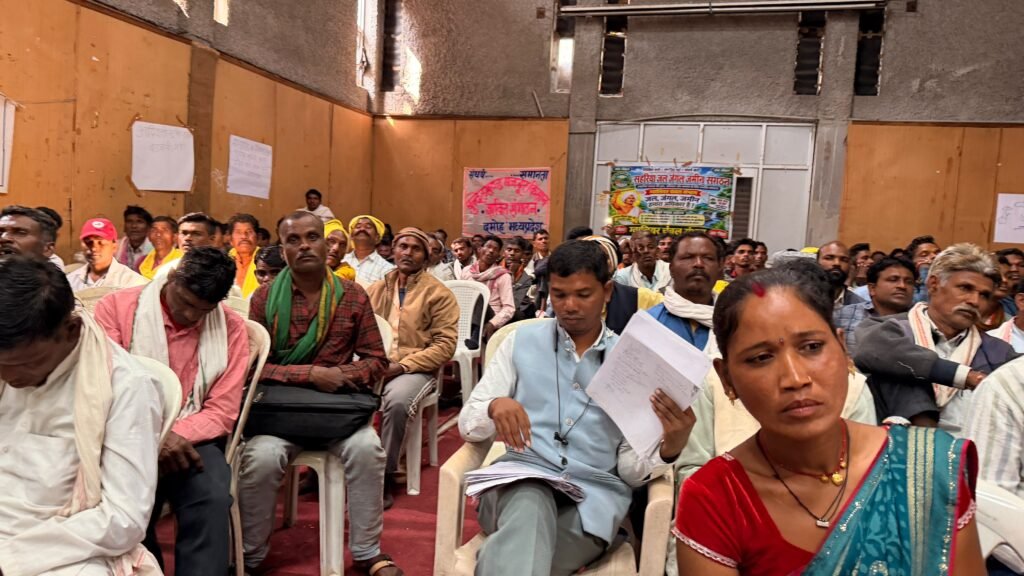
The Madhya Pradesh government receives the largest amount of funding and profits in the name of conservation, while on the other hand, the state government is taking tree felling and deforestation heavily in the name of projects and development, polluting the air and water. In this context, testimony was presented regarding various dam projects on the Ken-Betwa in Panna, the Narmada River in Mahakoshal, and nuclear projects, covering violations ranging from rights violations to forest exploitation, human rights violations, armed exploitation, compensation, and violations of Gram Sabha consent.
In the name of compensating for deforestation caused by these projects, the Forest Department is continuously promoting interventions related to plantation and forest privatization. In Gwalior, Seoni, Vidisha, Singrauli, Mahakaushal, Malwa, Nimar, and Bundelkhand, activities like digging pits, fencing, and planting trees are being carried out on people’s individual and community forest land. People are being deprived of their own community resources and land for farming.
The Forest Rights Act, introduced 20 years ago to address historical injustices, continues to this day. In fact, these injustices and atrocities have significantly increased. Amongst all these roadblocks the act itself is being converted by the ruling government into a beneficiary scheme. From governance and rights, the act is being packaged into a beneficiary scheme as evident from the Dharti Abha Janjatiya Gram Utakarsh Abhiyan (DA JGUA) where money is being poured in name of forest rights and forest department and tech agencies are given more power to interfere in matters of FRA. Political and administrative apathy is a major reason behind the lax implementation of the Forest Rights Act.
The public hearing testimonies clearly indicate that the Forest Department itself is creating the biggest obstacle to FRA’s implementation. Regardless of what the Forest Department says, they are openly violating and disregarding the law on the ground. The reasons behind this are clear- the profits the Forest Department makes from the ownership and control of forest resources and consolidation of forest land, and the vested corporate interest in these resources and land.
On 15th November, the government celebrates Janjaatiya gaurav diwas while its state machinery denies rights, evicts, displaces, criminalizes, dispossesses and kills the Adivasi and exploit their forest and resources. Even after 20 years, forests and forest areas are still trapped in the same colonial and capital-centric system from which the Forest Rights aims of liberating them and establishing a Gram Sabha-based democratic governance.